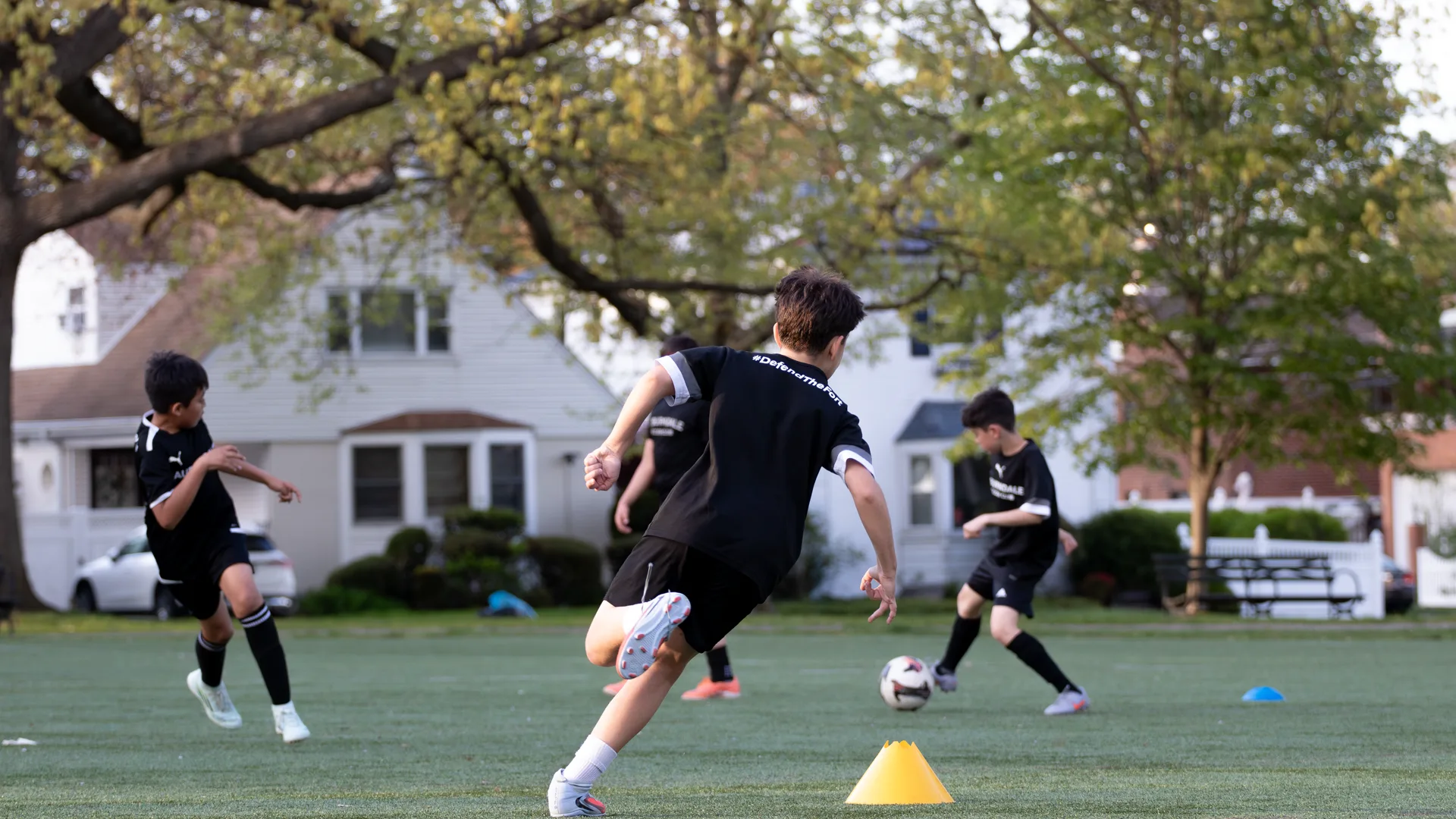
 By Auburndale Soccer Club
If your kid is genuinely good and genuinely loves soccer, at some point — usually around U-12 or U-13 — the question gets asked: "Could they play in college?" The honest answer is "maybe," and the path to find out is longer and quieter than most parents realize.
This is what the real pathway looks like, year by year, from U-9 club soccer to a college roster.
U-8 to U-10 (ages 7–9): just play
The right thing to do at this age is play a lot of soccer. That's it. Pickup. Backyard. Club. School yard. The kids who become college-level players almost always have one thing in common at age 8: they spent a lot of unstructured time with a ball at their feet. Not deliberate practice yet — just play. The technical foundation is being built and they don't know it.
Travel teams at this age are fine and fun, but the difference between a U-9 Travel kid and a U-9 Intramural kid is small. Both will catch up to each other if they keep playing.
U-11 to U-12 (ages 10–11): the first inflection
This is where the gap starts to open. Travel kids are now training three to four times a week and playing a full year of competitive games. Intramural kids are training once a week. By U-12 the difference in technical level is real and visible.
If a kid is going to be a serious player long-term, this is when the family commitment starts to take shape. Not because they need to specialize (they shouldn't yet — kids should still play other sports). But because they need to be in an environment with good coaching and competitive games. A bored 11-year-old playing rec when they're ready for travel will lose interest.
U-13 to U-14 (ages 12–13): the real game arrives
Full 11v11 on a full-size field. The game gets faster, more tactical, more physical. Some kids — especially late bloomers — start to show a level coaches notice. ID camps and showcase tournaments enter the picture. The first conversations about "playing at a higher level" start happening: should we move from a club Travel team to an academy or ECNL program?
If a player is exceptional, this is the age range where they may move to a US Soccer Development Academy (USSDA), ECNL (Elite Clubs National League), or NPL program. Those tiers play at a higher level than most local club Travel and they're geared toward college recruiting. The trade-off is a much bigger commitment in time, travel, and money.
Most college-bound players come up through their local club until U-13 or U-14, then move to a higher-level program for the final years. A handful stay at their hometown club and still get recruited. Both paths exist.
U-15 to U-16 (ages 14–15): high school, ID camps, and the first college contact
By now the family has decided whether to keep the kid in club soccer year-round or split between club and high school. (NCAA rules used to limit when college coaches could contact players; current rules allow contact starting in junior year. Things change frequently — keep an eye on it.)
ID camps run by college programs become a real thing. These are 1- to 3-day camps where college coaches watch a couple hundred kids over a weekend. They cost real money and most of them don't lead anywhere directly — but they're how college coaches build their first list of names. The right answer for most families is to attend two or three per year, mostly at schools the player is realistically interested in.
Showcase tournaments — Disney College Showcase, Surf Cup, Jefferson Cup — pull college coaches who watch dozens of teams in a weekend. If a player's club team plays in those, that's where the bulk of recruiting happens.
U-17 to U-19 (ages 16–18): the recruiting endgame
By junior year of high school, the player and family should have a target list of 15–25 colleges across academic, athletic, and financial fit. Coaches start reaching out (or not). The family sends video. Visits happen. Offers come — for some players. Most players who imagined college soccer at age 12 don't end up playing at a Division I program. Many end up at D-II, D-III, or NAIA. Some don't end up playing in college at all.
This is where the parent role gets quiet. The college recruiting process is mostly the player's responsibility — emails, video, conversations with coaches. Parents help with logistics and reality-check decisions. They don't run point.
The honest stats nobody wants to share
Of every 100 kids who play U-12 club Travel:
- Roughly 60 are still playing some form of organized soccer at U-15
- Roughly 25 play soccer in high school
- Roughly 5–8 play in college (across all divisions including D-III and NAIA)
- Roughly 1 plays at the Division I level
- Almost none play professionally
These numbers vary by club, by region, by gender. But the shape is consistent: the funnel is steep. A kid who's a star at U-10 in Queens may or may not be a star at U-15 — most aren't, because the field has filled in around them. That's not a failure. It's how every sport works.
What this means for parents
Two things. First: don't burn the family's time, money, and emotional energy on a college-soccer dream when the kid is 9. It's too early to know, and the cost of overinvesting is high — burnout, broken relationships with the sport, financial strain. Let them play, let them love it, see what they're like at U-13.
Second: when the kid is 13 or 14 and clearly has the level and the love, take it seriously. Find a club playing at the right tier. Pick the right ID camps. Have honest conversations about academic fit at the colleges they're targeting — soccer alone isn't going to get them in, and a kid who can play D-III at a good academic school is in a much better long-term spot than a kid who chases a D-I scholarship at a school they don't really want to be at.
Auburndale's Travel program runs U-8 through U-16. Players who've come through the club have gone on to college soccer at multiple levels. The pathway is real — it just takes a long time and almost never looks like the highlight reel.
See the Travel program details or read the college pathway page.